Verb (Group 2) (Basic ㊦ 243)
Someone or something is passively/spontaneously visible.
Equivalent: Be visible; (can) see; look ~
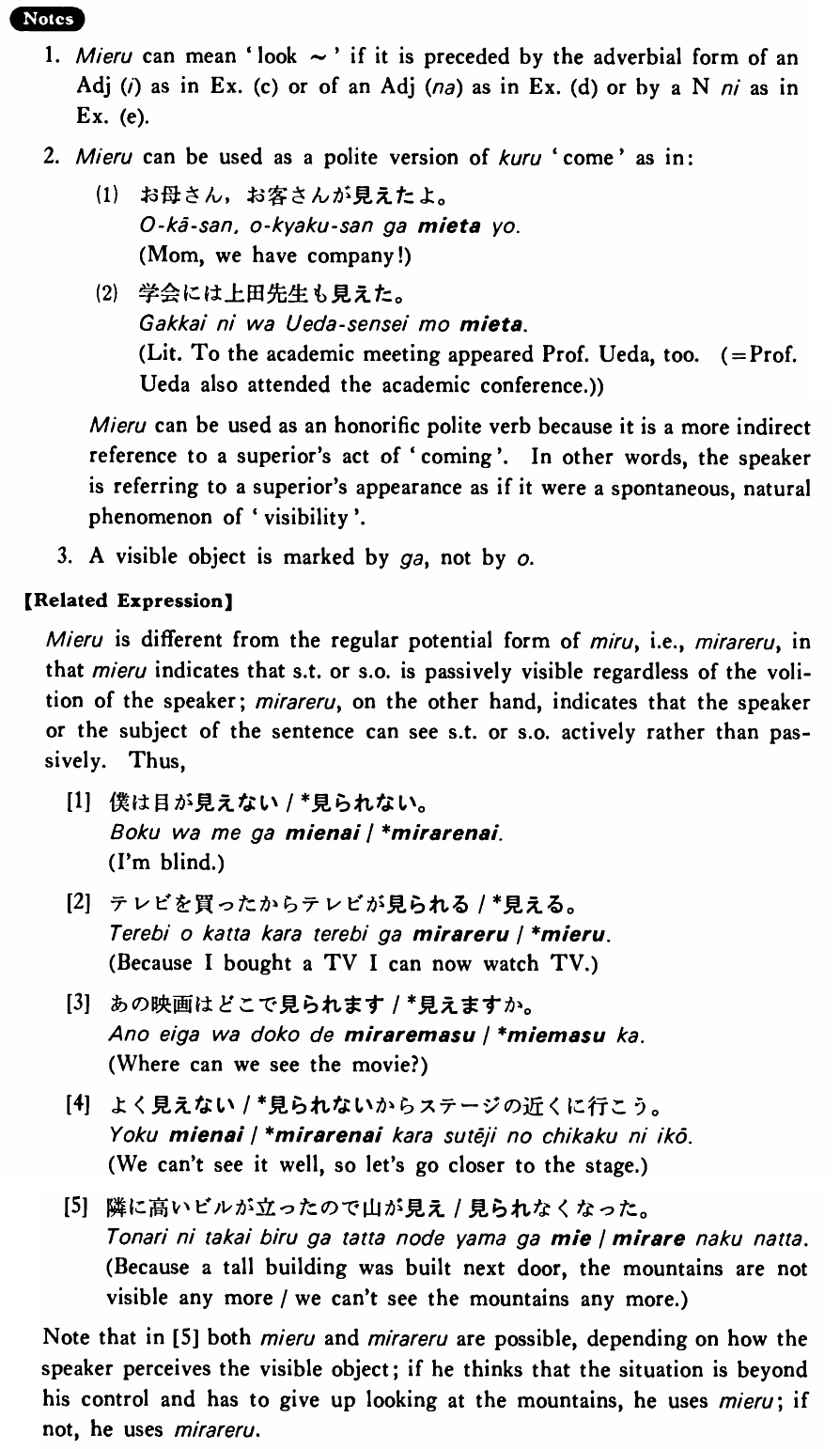
1. 見える can mean 'look ~' if it is preceded by the adverbial form of an Adjective い as in Example (c) or of an Adjective な as in Example (d) or by a Nounに as in Example (e).
2. 見える can be used as a polite version of 来る 'come' as in:
見える can be used as an honorific polite verb because it is a more indirect reference to a superior's act of 'coming'. In other words, the speaker is referring to a superior's appearance as if it were a spontaneous, natural phenomenon of 'visibility'.
3. A visible object is marked by が, not by を.
【Related Expression】
見える is different from the regular potential form of 見る, i.e., 見られる, in that 見える indicates that something or someone is passively visible regardless of the volition of the speaker; 見られる, on the other hand, indicates that the speaker or the subject of the sentence can see something or someone actively rather than passively. Thus,
[1]
[2]
[3]
[4]
[5]
Note that in [5] both 見える and 見られる are possible, depending on how the speaker perceives the visible object; if he thinks that the situation is beyond his control and has to give up looking at the mountains, he uses 見える; if not, he uses 見られる.